
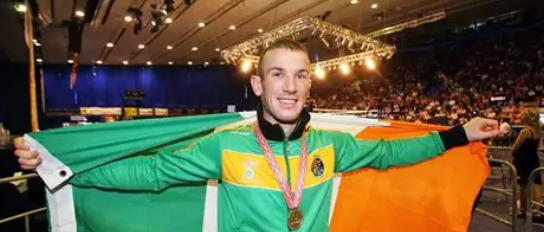
Irish Boxing Digest is delighted to launch a new series celebrating the men and women who have helped make Irish amateur boxing to be respected the world over. Irish Amateur Greats will look back at the careers, achievements and defining performances of the boxers who carried the Irish vest onto the biggest stages in world boxing. For the first instalment, we begin with one of the most naturally gifted amateurs Ireland has produced: Mullingar’s John Joe Nevin, an Olympic silver medallist, two-time World Championship bronze medallist and European champion whose career was defined by his extraordinary performances against the very best.
There are few Irish amateur boxers of the modern era whose careers can match the achievements of John Joe Nevin. An Olympic silver medallist, two-time World Championship bronze medallist and European champion, Nevin spent much of his career competing against fighters who would go on to become Olympic and professional world champions. Yet his legacy is about more than the medals. At his best, particularly when facing the biggest names on the international stage, Nevin possessed the sort of natural ability that made elite boxing look effortless.
Born in June 1989 in Mullingar, Co. Westmeath, Nevin emerged from the proud fighting tradition of the Irish Travelling community. His rise began at a remarkably young age and, by his late teens, he was already making an impression on fighters who would themselves go on to reach the highest levels of the sport.
One of those fighters was Liverpool’s Paul Butler, who would later become a professional world champion. Butler faced Nevin in Dublin in 2006, when both were still young amateurs, and although Butler came away with a narrow 23-21 victory, he had already been given a glimpse of what was to come.
“I remember watching him and telling me dad he was class,” Butler recalled. “He was a great boxer, very clever, cute, smart with his shots. Didn’t waste much John Joe. I knew I had to be on it to win, as I said before I’d watched him two weeks before so I was prepared for a tough fight.”
That defeat did little to slow Nevin’s progress. In 2007 he travelled to Lithuania and defeated home favourite Evaldas Petrauskas, who would later win an Olympic bronze medal. By then, Nevin was beginning to establish himself as one of the most promising young boxers in Europe.
Making His Mark
The breakthrough year came in 2008. Nevin won the Irish title with an 8-3 victory over TJ Doheny, another fighter who would later become a professional world champion, before securing qualification for the Beijing Olympics with an impressive victory over Moldova’s experienced Vyacheslav Gojan in Italy.
Before heading to China, Nevin added European Union gold to his growing collection. Competing in Poland, he defeated home favourite Mateusz Mazik 11-4, another indication that he was comfortable performing in hostile surroundings.
At just 18 years of age, Nevin arrived at the Beijing Olympics as one of the youngest fighters in the competition. His opening bout brought a measure of revenge when he faced Algeria’s Abdelhalim Ourradi, who had beaten him only three months earlier. This time Nevin was a different proposition, winning 9-4 to progress to the second round.
There he faced Mongolia’s Enkhbatyn Badar-Uugan, who would eventually win the Olympic gold medal. Nevin’s first Olympic campaign ended with a 9-2 defeat, but the experience was invaluable. At an age when many boxers were still establishing themselves domestically, Nevin had already competed at the world’s biggest sporting event.
Over the next four years, he would develop into one of the world’s leading amateurs.
In 2009, Nevin retained his Irish title by defeating Ryan Lindberg and went on to win silver at the European Union Championships in Denmark. His route to the final included a hugely impressive 13-2 victory over Luke Campbell, the Englishman who would become one of the defining opponents of Nevin’s career.
That year he also defeated Wales’ Andrew Selby, another future Olympian, before travelling to Milan for the World Championships. Nevin reached the semi-finals and secured a bronze medal, losing a narrow 5-4 decision to Russia’s Eduard Abzalimov.
The World Championship medal confirmed his place among the elite, but Nevin’s 2010 campaign would bring both another Irish title and a difficult lesson. He defeated Derek Thorpe to retain his national crown but was beaten 7-1 by England’s Gamal Yafai at the European Championships.
Yafai, who would later become European super-bantamweight champion as a professional, was still establishing himself at senior international level when he first encountered Nevin. He had already won a Youth World Championship silver medal as a 16-year-old and an English senior ABA title at 17, but knew he was stepping up in class against an established world-level amateur.
“I heard of him many times before I had boxed him from my older brother Kal,” Yafai recalled. “I was a new kid on the block just turning senior. At 16 years old I won a world silver, then an England senior ABA title at 17 but wasn’t proven as a senior at the international level. I was up against it as Nevin was top four in the world and I just gave it my all.”
The two would meet again after Yafai returned from a lengthy lay-off following hand surgery. This time, Nevin got the verdict, edging Yafai 10-9 at a tournament in Poland.
“I wasn’t nowhere near my best and he beat me 10-9 on points,” Yafai said. “Either way we was both good fighters on our day and very little between us. He went on to win Olympic silver while I was second best to Luke Campbell, rightly so.”
The bouts with Yafai were part of a period in which Nevin was consistently testing himself against the strongest opposition available. He also began competing several times in the World Series of Boxing, the five-round amateur format that brought many of the world’s best fighters together. His involvement was another reflection of his standing in international boxing.
By 2011, Nevin was back to winning ways domestically and internationally. He won another Irish title, defeating Tyrone McCullough, and claimed revenge over Yafai with a 10-9 victory in Poland. At the European Championships he narrowly lost 13-12 to Russia’s Dmitry Polyansky in the quarter-finals, but his biggest opportunity of the year was still ahead.
At the World Championships in Baku, Nevin once again reached the medal stages. Waiting in the semi-final was Luke Campbell, and their latest meeting proved to be as close as ever. The bout finished 12-12 before Campbell advanced on countback, leaving Nevin with another World Championship bronze medal.
The defeat was frustrating, but the tournament also delivered something hugely important: Olympic qualification.
Nevin was heading back to the Games, this time as a proven world-class amateur rather than the 18-year-old who had made his Olympic debut in Beijing.
London 2012
If Beijing had been an introduction to the Olympic stage, London 2012 was Nevin’s defining moment.
He began his campaign by defeating Denmark’s Denis Ceylan before progressing past Kazakhstan’s Kanat Abutalipov. In the quarter-finals came Mexico’s Oscar Valdez, a fighter who would later become a professional world champion.
Nevin beat him to move into the semi-finals, where he faced Cuba’s Lazaro Alvarez.
Alvarez entered the contest as one of the tournament’s leading gold-medal favourites. Cuba had long been the dominant force in amateur boxing and Alvarez was regarded as one of the finest technicians in the division. Nevin, however, produced perhaps the finest performance of his career.
His footwork and timing were outstanding, allowing him to control the distance and repeatedly beat Alvarez to the punch. He used his movement to frustrate the Cuban, picked his attacks intelligently and never allowed the occasion to overwhelm him.
It was a masterclass.
Against one of the most highly regarded amateurs in the world, Nevin produced the sort of performance that demonstrated exactly why he had become such a feared international opponent. The victory sent him into the Olympic final, where Luke Campbell awaited.
The final was fiercely contested in front of a partisan home crowd. Nevin and Campbell had already shared several close encounters throughout their amateur careers and there was little to separate them once again. Campbell ultimately took the gold after a 14-11 victory, leaving Nevin with Olympic silver.
It was a result that could easily have been different. The margins between the pair had been so fine throughout their careers that another outcome was certainly within the realms of possibility.
For Nevin, though, the London Games had transformed his career from an impressive collection of international medals into something far greater. He was now an Olympic medallist and one of the most respected amateur boxers in the world.
Sean McComb, who faced Nevin in the 2012 Irish Championships, offers an interesting insight into why the Mullingar man could sometimes appear to be a different fighter on the international stage.
McComb pushed Nevin all the way before losing 13-12 and still believes he had a chance of winning the contest.
“I personally believe I could of beat him but the difference was at the time I was a boy and he was a man,” McComb said.
But McComb believes there was another important factor to Nevin’s performances.
“John Joe always underperformed on the national stage, he didn’t see any threat from the competition. But when he boxed internationally against all the big countries, he was absolutely phenomenal.”
McComb saw exactly what he meant during a two-week training camp in Kazakhstan, one of the strongest amateur boxing nations in the world.
“I remember most of the team getting bashed up by all these Kazakh’s and then John Joe got in and made it look so easy and was just dominating everybody, and he wasn’t even fit,” he recalled.
It was an observation that neatly captures Nevin’s reputation. Against the very best, he seemed to find another gear.
“His best attributes where his footwork and timing, he also was very heavy handed and great fighter all round,” McComb said.
Those qualities remained evident after London, as Nevin went on to add another major title to his collection.
European Champion
In 2013, Nevin became European champion in Minsk. He defeated Russia’s Vladimir Nikitin in the semi-final before overcoming Ukraine’s Mykola Butsenko in the final to claim gold.
By then, his medal collection had become extraordinary. Olympic silver, two World Championship bronzes, European gold, European Union gold and silver, along with multiple Irish titles, represented the reward for years spent competing against the best amateurs in Europe and beyond.
The Minsk tournament also served as a fitting reminder that the Olympic final had not marked the end of Nevin’s time at the top. He remained one of Europe’s elite and was still capable of beating the best fighters on the continent.
His final amateur appearance came in France at a Multi Nations Cup, where he finished his career with another international tournament victory, defeating Poland’s Dawid Michelus in the final.
It was an appropriate way to close the amateur chapter: another international title, another victory over a highly regarded opponent and another reminder of the level at which Nevin had operated for almost a decade.
The Legacy of John Joe Nevin
Nevin’s amateur career is remarkable not simply because of the medals he won, but because of the names attached to them.
He defeated future Olympic medallists, future Olympic champions and future professional world champions. He competed against the world’s strongest amateur nations and repeatedly found a way to perform when the level was highest.
He lost too, of course. He lost to Paul Butler as a youth, to Enkhbatyn Badar-Uugan in Beijing, to Gamal Yafai in 2010 and to Luke Campbell in two of the biggest fights of his career. But those defeats are part of what makes the story compelling. Nevin continually came back, learned, adapted and produced some of the best boxing of his career when the stakes were greatest.
Paul Butler remembers the clever young boxer he encountered in Dublin. Yafai remembers the established world-class amateur who was already regarded as one of the best in the division. McComb remembers a fighter who could step into a ring with world-class Kazakh opposition and make it look easy.
Their recollections reinforce something that the record alone cannot fully convey: John Joe Nevin was a hugely gifted boxer who seemed to thrive when the quality of the opponent demanded it.
The Olympic silver medal in London will always be the centrepiece of his amateur career, particularly the extraordinary semi-final performance against Lazaro Alvarez. But the road to that medal began years earlier, on small stages and in domestic competitions, and was built through victories over fighters who would later become stars themselves.
From Mullingar to Beijing, from Milan and Baku to Minsk, John Joe Nevin established himself as one of the finest amateur boxers Ireland has produced.
His professional career has since continued the story, and as of 2026 he remains unbeaten. But whatever comes next, his amateur legacy is already secure.
John Joe Nevin was not merely an Olympic silver medallist.
He was one of the great Irish amateur talents of his generation.


Leave a comment