
Some fighters leave behind records. Others leave behind moments, memories and stories that continue to define them long after their final bell.
The 13th Round: Legends Remembered is our series looking back at the careers of boxing’s most memorable figures — the champions, contenders and characters whose impact on the sport cannot be measured by wins and losses alone.
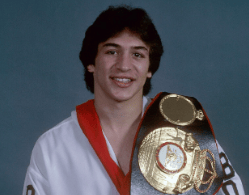
For our second instalment, we turn to one of the most beloved fighters of the 1980s: Youngstown’s own Ray “Boom Boom” Mancini.
His professional career lasted just five and a half years, yet within that remarkably short period he became a world champion, one of the most popular fighters in America and one of the defining personalities of boxing’s golden era.
Mancini’s career contained almost everything the sport can offer: a family legacy, world-title glory, brutal championship battles, painful defeats, a tragic night and, ultimately, recognition in the International Boxing Hall of Fame.
But Mancini’s story begins long before the lights of Las Vegas, Madison Square Garden or any of boxing’s biggest stages.
It begins in Youngstown, Ohio.
A FAMILY LEGACY
Mancini was the youngest of three children, raised by parents whose influence would shape his life in very different ways. His mother was of Irish descent and his father was Sicilian, and Mancini remains particularly conscious of the role both played in his development.
“I had wonderful parents,” he says. “My father was always my inspiration but my mother was my motivation.”
His mother gave him the belief that he could achieve whatever he wanted, providing the confidence that would become so important throughout his life.
“She use to say, ‘Raymond, you can be whatever you choose to be in this life. The only limitations that you have, are the ones that you put on yourself.’”
His father was the man he looked up to.
“My father was everything that I wanted to be, as a man, as a father, as a husband and especially as a fighter.”
Lenny Mancini had been a leading lightweight contender and, in 1942, was ranked No. 1 in the world. He had signed to challenge for the lightweight championship in February of that year, but was drafted into the US Army in January and was not granted a reprieve to take the fight.
His dreams of being a world champion was effectively ended.
Lenny became a frontline infantryman and was wounded at the Battle of Metz, later receiving both the Purple Heart and Silver Star. For Ray, the story of what his father might have achieved without the war was something he heard throughout his childhood.
“I always heard that if it wasn’t for WW2, he would’ve become World Champion,” he says.
That belief became part of Mancini’s own ambition. As a child he had already decided that boxing would be his future.
“Since I was a little boy, 7, 8 years old, I said that one day I was gonna be a fighter and World Champion for my father.”
Interestingly, it was his father who initially tried hardest to persuade him to choose another path. Mancini had an academic scholarship to college and a professional baseball offer, giving him alternatives that most aspiring young fighters could only dream of.
But Ray had already made his decision.
“He was the one who tried very hard to talk me out of it,” Mancini recalls. “But I told him, ‘Dad, I wanna win that world title for you.’ What was he gonna say?!”
“BOOM BOOM”
When Mancini turned professional in 1979, he inherited more than his father’s passion for boxing. He also inherited his nickname.
“Boom Boom” had originally belonged to Lenny, but it quickly became synonymous with Ray as his professional career gathered momentum.
Rather than seeing the name as something he had to live up to, Mancini regarded it as a source of motivation.
“Being called Boom Boom, since I was a kid, always gave me motivation in whatever sport I played, in whatever endeavor I tried,” he explains. “I never felt that it brought me pressure of any kind.”
That attitude was reflected in the way he fought. Mancini quickly became known for his aggressive style, relentless work rate and willingness to engage opponents at close quarters. He was an exciting fighter at a time when boxing had no shortage of stars, and his personality and connection with Youngstown helped turn him into a genuine fan favourite.
He turned professional with a stoppage of Phil Brown and, remarkably, was challenging for a world title just two years later.
The opponent waiting for him was not simply a champion.
He was one of Mancini’s childhood heroes.
ALEXIS ARGUELLO: THE FIRST TITLE SHOT
Alexis Arguello and Roberto Durán were the two fighters Mancini most enjoyed watching on American television as a youngster. By 1981, one of those men was standing across the ring from him with a world championship at stake.
Arguello was already an established great, possessing the technical ability and experience that had made him one of the most respected fighters of his generation. Mancini was the young challenger bringing youth, strength, aggression and enthusiasm into the biggest fight of his career.
He remembers clearly what separated Arguello from most opponents.
“What made Alexis so great was his boxing IQ, his precision punching and his composure,” Mancini says. “He never lost his composure in the ring and of course his experience.”
That experience ultimately proved decisive. Arguello stopped Mancini in the 14th round, but the performance did not damage the reputation of the young challenger. Instead, Mancini had demonstrated that he belonged at world level.
The aftermath of the fight produced one of the most touching moments of his career.
At a tearful post-fight press conference, Mancini spoke about his father comforting him after the defeat.
“I told him I’m sorry and like all fathers do, he comforted me,” Mancini said.
Arguello interrupted.
“You did beautifully.”
The Nicaraguan then walked over to Mancini and tussled the youngster’s hair, an extraordinary display of respect after a fiercely contested championship fight.
Arguello was also keen to explain why he had prevailed.
“I think it was my experience that helped in there….in fact I know it,” he said.
But Arguello’s assessment of Mancini was perhaps even more significant.
“He was one of the toughest I ever faced.”
For Mancini, the defeat provided a valuable education. He had experienced first-hand the importance of championship experience, composure and ring intelligence, and when another opportunity arrived the following year, he was determined to make it count.
ONE ROUND TO BECOME WORLD CHAMPION
In 1982, Mancini received his second opportunity to become world champion, this time against Arturo Frias for the WBA lightweight title.
There was no repeat of the 14-round battle with Arguello.
After getting rocked early, Mancini stopped Frias in a first-round war and finally achieved the dream he had carried since childhood.
For a fighter whose motivation had been so closely tied to his father, the achievement carried enormous emotional weight.
“When the referee stopped my fight against Arturo Frias, the feeling I had was euphoric,” Mancini recalls. “I was on the top of the world.”
He then puts that feeling into extraordinary perspective.
“The only time that I felt that type of euphoria, was seeing each one of my children born.”
It is difficult to find a more revealing description of what becoming world champion meant to Mancini. The belt represented the culmination of a promise made by a young boy to his father, whose own opportunity had been taken away by war.
Even now, Mancini says that thinking about the night brings back only positive memories.
“Yes, thinking about that day brings nothing but good thoughts and feelings.”
After the disappointment of the Arguello defeat, Mancini had reached the top.
And he intended to stay busy once he got there.
AN ACTIVE CHAMPION
Mancini’s championship reign lasted from May 1982 until June 1984, and one of the things he remains proudest of is how frequently he defended his title.
He fought seven times during those two years, including five world-title defences, four of which he won, as well as two successful non-title fights.
“I was very proud that I had 5 title defences, 4 successful. Also, 2 successful non-title fights,” he says.
For Mancini, the importance of those non-title appearances went beyond simply adding victories to his record. A champion had to remain visible and active, because credibility could disappear just as quickly as a title belt.
“Though your title is not at stake, your credibility and marketability are.”
His activity remains a source of genuine pride.
“In 2 years as champ, from May of ’82 to June of ’84, I had 7 fights. That’s one every 3 months. I was an active champion, I’m very proud of that, it means a lot to me that people remember my fights.”
Mancini defeated Ernesto España and successfully defended against Orlando Romero at Madison Square Garden before stopping former world champion Bobby Chacon in three rounds in 1984.
By that stage, “Boom Boom” was one of the most recognisable fighters in the sport.
But his reign also contained the fight that would show the world the reality of the dangers of the sport and remain with Mancini for the rest of his life.
KIM DUK KOO TRAGEDY
On November 13, 1982, Mancini defended his WBA lightweight championship against South Korea’s Kim Duk Koo in Las Vegas.
The fight became one of the most brutal championship contests of its era. Mancini eventually stopped Kim in the 14th round, but the victory was followed by devastating news.
Kim had suffered severe injuries and died several days later. He was only 23 years old.
The tragedy remains one of the defining chapters of Mancini’s life and highlighted that beyond the glitz and glamour of the sport, there is a real danger each and every time a boxer steps into the ring. And this is something I think, fans and reporters, need to remember when they feel like criticising a fighter.
THE FIGHTS THAT GOT AWAY
Mancini’s championship reign was busy, but even an active champion can look back and wonder about the fights that never came together.
Hector Camacho is one of the clearest examples. The two would eventually meet, but not until Mancini had been retired for four years.
“Though we fought later on, after I was 4 years retired, it should’ve happened in early 1984,” Mancini says.
Aaron Pryor was another opponent Mancini wanted.
He acknowledges Pryor’s ability but believes the styles would have favoured him.
“He was great but stylistically, I thought he was perfect for me.”
Then there was Kenny Bogner, a fight that Mancini was scheduled to have twice before injuries forced him out on both occasions.
Bogner subsequently questioned the legitimacy of those injuries, something Mancini clearly remembers.
“Of course he made light of my injuries and said that I pulled out on purpose.”
His response decades later still carries the competitiveness of the man that became world champion.
“I couldn’t stand him and would’ve beaten him good. I would’ve busted him up!”
It is one of the more colourful moments in an interview that otherwise reveals a reflective Mancini looking back on his career with considerable honesty.
LIVINGSTONE BRAMBLE
The man who ultimately took Mancini’s title was Livingstone Bramble, whose style presented a very different challenge.
Bramble’s length, defensive structure and counter-punching ability made him difficult for Mancini to attack effectively.
“Stylistically, Bramble was difficult,” Mancini explains. “He was long, rangy, kept his arms tight, elbows close to his sides and was a good counter puncher.”
Their first fight ended in a close decision victory for Bramble, and Mancini remains convinced that the rematch should have gone his way.
“The second fight I thought that I won, I felt that I out punched him, out hustled him but he got a close decision.”
At the same time, Mancini accepts that their rivalry was always likely to produce close contests because of the styles involved.
“Every fight with us would’ve looked the same, with each outcome very close, very dogged and could go either way!”
The respect between the two men was demonstrated after their second meeting, when Bramble offered Mancini a remarkable compliment despite having taken his championship.
“I love you, Ray. You fought a great fight.”
It was a fitting acknowledgement from one fighter to another after two closely contested battles that had pushed both men to their limits.
WHAT MANCINI WOULD TELL HIS YOUNGER SELF
Mancini eventually retired with a record of 29 wins and five defeats, with 23 victories coming inside the distance.
Looking back now, however, he doesn’t wish he had been more aggressive or more ambitious. Instead, the advice he would give his younger self is centred on something much more important: his health.
“If I was going to give a young me advice, it would be; to be more concerned with my health,” he says.
Mancini admits that his desire to fight and his concern about disappointing his supporters sometimes outweighed his better judgement.
“If I had to pull out of a fight, to do so and not worry so much about disappointing the fans,” he explains, adding that he needed to recognise that he could always “fight another day.”
The lesson comes from experience rather than hindsight alone.
“Not to go into a fight, not being a 100%, which I did and it cost me my title.”
It is an unusually candid admission from a fighter whose reputation was built on his willingness to keep going regardless of the circumstances. The same toughness that made Mancini such a popular champion could also make it difficult for him to know when stepping away was the correct decision.
THE COMEBACK
Mancini’s retirement did not last forever.
Four years after walking away, he returned to boxing in 1989 and finally faced Hector Camacho, the opponent he had wanted during his championship years.
The circumstances, however, were very different from those imagined in 1984. Mancini had been away from the sport for four years and was now challenging for the vacant WBO title.
Camacho won a close split decision.
Mancini returned once more against Greg Haugen, but that fight ended in defeat and marked the final appearance of his professional career.
His record stood at 29-5 with 23 knockouts.
For a fighter who had packed so much into such a short period, there was little left to prove.
FIVE AND A HALF YEARS — AND THE HALL OF FAME
In 2015, Mancini was inducted into the International Boxing Hall of Fame, an honour he regards as one of the greatest accomplishments of his life.
Yet when the call came, it wasn’t something he had expected.
“To be recognised for my career and be inducted into the ultimate location of our sport, is one of the greatest accomplishments of my life,” Mancini says.
The surprise came from the length of his career.
“It was never my goal, nor a thought that I would ever be inducted. I didn’t think that I had fought long enough to warrant it.”
Mancini had always associated Hall of Fame careers with fighters who had competed for 10, 12 or even 15 years. His own professional career lasted only five and a half.
But the reporter who informed him of his induction offered another interpretation.
The length of the career was not the important factor.
It was the quality of the opposition and the impact Mancini had during those years.
“I said, ‘then I’ll take it!’”
It is difficult to argue with the conclusion.
In those five and a half years, Mancini fought Alexis Arguello, became a world champion, made four successful defences, fought Bobby Chacon and Livingstone Bramble, became a major American boxing attraction and left a lasting impression on the sport.
The career may have been short.
The impact was not.
LIFE AFTER BOXING
Mancini has remained involved in the sport since retirement, working in commentary and consulting and continuing to follow the modern generation.
When asked which current fighters impress him most, his choices are Naoya Inoue, David Benavidez and Oleksandr Usyk.
It is a reminder that, despite having been away from competitive boxing for decades, Mancini has never really moved away from the sport itself.
The same enthusiasm that took him from Youngstown to a world championship remains evident when he talks about boxing’s current stars.
And there is now the possibility that his own story could reach a new audience through film.
THE MANCINI STORY ON THE BIG SCREEN
Mancini says he was approached more than a year ago about a potential movie. The central story would involve the Kim Duk Koo fight, Kim’s life and the circumstances surrounding that period of Mancini’s career.
Several actors have been mentioned, including Ireland’s Barry Keoghan.
Mancini says he would be honoured by any of the actors being considered.
“Barry Keoghan has been mentioned, as well as a couple of others. All terrific actors, who I’d be honoured if they played the part.”
For now, however, the project remains dependent on the business side of filmmaking.
“When the money is there, then we’ll figure out who we make the offer to.”
And as for Keoghan?
“I hope that Keoghan is available then.”
“ICEMAN” JOHN SCULLY ON RAY MANCINI
Few people are better placed to appreciate what makes a great fighter than someone who has spent his own life inside the boxing world.
Former world title challenger John “Iceman” Scully is now one of the sport’s most respected voices and coaches. Speaking to the Irish Boxing Digest he gave his assessment of Mancini.
Scully particularly admired the way Mancini closed distance and attacked with both hands.
“I really liked the way he worked his way to the inside and used both hands to the body. Very skilled and impressive in how he did it.”
“I think Ray had tremendous heart and was actually a very good body puncher.”
Scully particularly admired the way Mancini closed distance and attacked with both hands.
“I really liked the way he worked his way to the inside and used both hands to the body. Very skilled and impressive in how he did it.”
Scully has also had the opportunity to get to know Mancini personally in recent years, giving his observations an added personal dimension.
“I have gotten to be friendly with Ray over the last few years actually. Sat at the table with him at a dinner in Cleveland in 2022 and had a great time talking his career with him! Very cool guy.”
Coming from someone as respected as John Scully, that is high praise.
THE 13TH ROUND
Ray Mancini’s career was like a shooting star because so much happened in such a short period and wont be forgotten. From the promise he made as a young boy to his father, through the defeat to Alexis Arguello and the triumph over Arturo Frias that finally made him world champion, Mancini packed an extraordinary amount into just five and a half years. He became one of America’s most popular fighters, made four successful title defences and fought some of the toughest men of his era.
And as John “Iceman” Scully observed, there was more to Mancini than heart and aggression — he was a skilled inside fighter with an impressive ability to work his way into range and attack the body with both hands.
His record reads 29 wins, five defeats and 23 knockouts, but the numbers alone cannot explain why Ray “Boom Boom” Mancini remains so fondly remembered. For that, you have to go back to Youngstown, to a boy that had already decided he would become a fighter and win a world title for his father. That boy kept his promise. Five and a half years was enough to make him a champion, a Hall of Famer and one of boxing’s most enduring characters. The Youngstown warrior may have left the ring, but Ray “Boom Boom” Mancini’s legacy is cemented in the sports history.


Leave a comment