
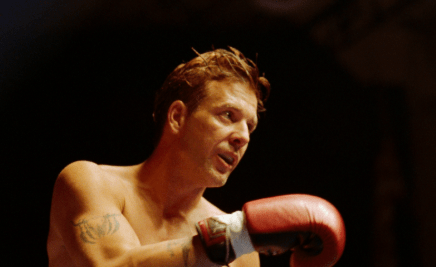
Welcome to the second instalment of Irish Boxing Digest’s “Beyond the Ring”, a series that looks beyond the fighters themselves to explore the people, characters and stories that help make boxing what it is. From trainers and promoters to those who have lived and worked around the sport, Beyond the Ring shines a light on the people whose connection to boxing often extends far beyond fight night.
For this instalment, we turn our attention to one of the most unexpected boxing stories of all — the fighting life of Hollywood star Mickey Rourke, whose relationship with the sport began long before he ever appeared on the big screen.
When people hear the name Mickey Rourke, their first thought might be Hollywood.
They’d be wrong.
Mickey Rourke was a fighter long before he was a movie star — a boxer who became an actor, not an actor who decided to try his hand at boxing. That distinction matters.
In an exclusive interview with Irish Boxing Digest, Rourke spoke about the boxing life that came long before Hollywood — the gyms, the fighters and trainers who shaped him, the career that was interrupted as a teenager, his decision to turn professional later in life, and why boxing remains such an important part of who he is.
Rourke didn’t discover boxing after fame. Boxing was there first. It shaped him, gave him somewhere to belong, and stayed with him long after Hollywood had made him famous.
He never became a fighter.
He was born one.
Long before 9½ Weeks, Angel Heart or The Wrestler — before Hollywood knew the face or the name — there was a young Mickey Rourke in a boxing gym. More than half a century later, when Rourke talks about boxing, that young fighter is still there.
For Rourke, boxing was home.
He began boxing as a boy, around the age of 11, and recalls 23 amateur fights over roughly six years, winning titles at 134 and 146 pounds. Rourke had a substantial boxing background years before he became an actor. And he could fight.
Rourke spent time around Angelo Dundee’s legendary Fifth Street Gym during one of the great periods in boxing history. Muhammad Ali, Jimmy Ellis, Oscar Bonavena and some of the greatest fighters ever all laced them up in that gym. And later he sparred countless rounds with the legends Roberto Duran and James Toney.
But Rourke wasn’t simply hanging around great fighters. He was being taught by them, too.
His trainers tell the story of how seriously he took boxing. As a boy, Rourke was trained by Willy Pastrano, the former light-heavyweight world champion. Then came Bill Slayton, followed later by Freddie Roach.
And then there was Marvin Somodio — Rourke’s favourite trainer, and a protégé of Roach.
Of all the trainers Rourke has worked with, Somodio appears to occupy a particularly special place. Rourke says the two of them “really clicked”, and the relationship went beyond simply working a corner or holding mitts. Somodio understood him.
“Ali was always so kind to me”
Not many today in boxing can say they spent personal time with the greatest of all time, Muhammad Ali, but Mickey Rourke can.
“Ali was always so kind to me,” Rourke remembers. “It was a great time and it kept me off the streets.”
Boxing did more than teach him how to fight. It gave a young man somewhere to belong.
Rourke has spoken previously about violence and instability in his childhood, and about finding a speed bag at a community centre that gave him somewhere to put the anger he was carrying. The gym became his refuge.
Jerry Quarry
If you want to fully understand Rourke’s relationship with boxing, ask him about Jerry Quarry, who is still his “old buddy” decades after his death.
Rourke met Quarry when he was around 11. Quarry was one of the great heavyweights of his generation, a fighter whose career unfolded in the shadow of Ali, Frazier and Foreman. He never became world champion, but he never needed a belt to earn the respect of fighters.
Quarry taught the young Rourke how to throw a left hook. “The right way,” as Rourke remembers it.
Decades later, he could still talk enthusiastically about Quarry’s fights, still admire the same left hook and still remember the man behind it.
When I asked Rourke about Quarry during our conversation, his affection for the former heavyweight was unmistakable.
When Quarry died at only 53 after years of devastating neurological decline, Rourke was with his family at the funeral.
“I really loved Jerry very much,” he says.
A dream INTERRUPTED
And just when Rourke was getting a reputation as a young prospect to keep an eye on and learning from greats like Quarry, boxing took something from him.
Rourke suffered repeated concussions as a young fighter, including several through sparring. At 16, a doctor told his mother that he could not afford to be hit in the head for at least six months.
For a teenager dreaming of becoming a professional, it was devastating.
The fighting ended but the dream didn’t.
Hollywood couldn’t replace boxing
When Rourke couldn’t continue boxing, acting tried to fill the void.
Rourke possessed something Hollywood could not manufacture — a realness that couldn’t be thought in acting school. By the 1980s he was one of the most magnetic actors in American cinema. But underneath it sat something unresolved.
The boxing career hadn’t ended because Rourke discovered he wasn’t good enough. It had been taken away.
And unfinished business has a habit of lingering in the back of a man’s mind.
By 1991, approaching 40 and already internationally famous, Rourke decided to become a professional boxer. For almost any other actor, it would have been absurd. For Rourke, it made perfect sense.
He had previously said he felt he was self-destructing and needed to return to the ring. When I asked him about that period and why he went back, his explanation today is simpler still:
“I just had to finish what I started.”
He knew he wasn’t beginning a conventional championship journey. The teenage welterweight prospect was gone; when he returned, he was fighting around the super-middleweight and light-heavyweight range.
What remained were the questions.
Could he still do it?
Could he make that walk to the ring?
On May 23, 1991, he proved to himself that he could, and Mickey Rourke made his professional debut against Steve Powell.
Between 1991 and 1994, he fought eight professional bouts. He won six, drew two and lost none, with five victories coming by knockout or stoppage.
“Turning pro ain’t an easy walk in the park,” he says.
Then comes the pure Rourke line:
“I only fought real pros. Not guys from some fishing village.”
There was pride in that statement because Rourke knew how his boxing was perceived. He was already famous, so people assumed the whole thing had to be a stunt. To him, they got the story backwards. He wasn’t an actor pretending to be a fighter. He was a fighter who happened to become an actor.
“Being a well known actor, no matter who I fought, there was so much negative haters,” he says. “They didn’t know I was amateur.”
Roberto Durán
Perhaps the best evidence of Rourke’s respect for boxing is the way he talks about his sparring with the legendary Roberto Durán.
Most people would use a story like that to embellish their reputation. Rourke does the opposite.
When bringing up his time sharing a ring with the Panamanian great, Rourke says:
“I never won a round with Duran. But learned so much.”
He stepped into the ring with one of the greatest fighters who ever lived, and showed that the ring is where Mickey Rourke belonged.
There is nowhere to hide in a ring. No second take. No stunt double. No editing room and no director to save you. It is where the truth is told and Rourke knew he could handle it. And he achieved what he set out to do at the beginning, he became a pro fighter.
But in 2014, two decades after his professional career had ended, Rourke did something almost nobody expected.
At 62, he walked into a boxing ring in Moscow against 29-year-old Elliot Seymour. Rourke dropped Seymour twice before the fight was stopped in the second round. In boxing, as he did in acting, Mickey Rourke done things his own way.
“She’s my champ”
Rourke still follows boxing closely and speaks warmly about Irish fighters, with particular admiration for Katie Taylor and former WBO Middleweight champion Andy Lee.
“She’s my champ,” he says about Taylor and has spoken about travelling to Ireland to watch Taylor fight if the opportunity arises.
The admiration makes sense. Lee and Taylor represent many of the qualities Rourke has always revered in fighters: honour, humility, courage.
The fighter never left
His life sounds more like a Hollywood script than anything a movie producer could come up with, but he lived it and the scars of battle are there.
And that is what makes Rourke’s story so compelling.
Boxing is not only for its champions. It belongs to the journeyman, the amateur, the sparring partner — to the 11 year old boy walking into a gym to release his anger.
Mickey Rourke belongs to that world, and it belongs to him.
When he talks about Jerry Quarry, he talks like somebody mourning one of his own.
When he talks about Durán, he talks like a student.
When he talks about Ali, he becomes the young kid at Fifth Street again.
And when he talks about Marvin Somodio, there is the same sense of loyalty that runs through his memories of the trainers, fighters and gyms that shaped him.
Hollywood gave Mickey Rourke fame.
Boxing gave Mickey Rourke life.
The actor never became a fighter.
He was a fighter all along.


Leave a Reply