
There are certain careers that cannot be properly measured by a single medal, no matter how prestigious that medal may be.
Kenneth Egan’s career is one of them.
The Clondalkin southpaw became one of the most accomplished amateur boxers Ireland has ever produced, building a career that stretched across more than a decade and saw him compete against, and defeat, some of the finest fighters of his generation.
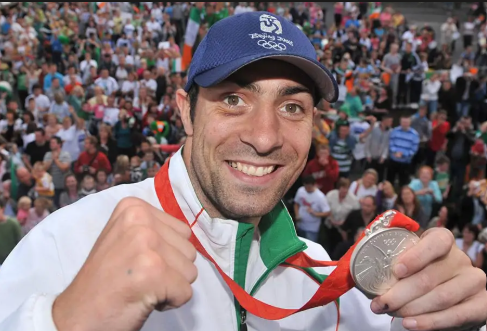
His crowning achievement came at the 2008 Olympic Games in Beijing, where he won an historic silver medal for Ireland.
But to understand Kenneth Egan’s place in Irish boxing history, you have to look beyond the Olympic podium.
His story is one of talent, technical brilliance, resilience, setbacks, friendship, rivalry and, ultimately influence. He did not simply win medals. He became the standard against which future Irish amateur boxers measured themselves.
And perhaps most importantly, he inspired the generation that came after him.
From Clondalkin to the national team
Born on 7 January 1982 and raised in Clondalkin, Egan came through Neilstown Boxing Club, where his natural ability and technically polished southpaw style quickly marked him out as a special talent.
He was never a fighter who relied solely on aggression or physical strength.
His boxing was built around skill, accuracy and an understanding of distance, with the kind of textbook technique that made him particularly difficult to deal with at amateur level.
Over the years, those qualities would take him from Irish championship success to the biggest stages in world amateur boxing.
Egan first announced himself at senior international level in 2001.
Competing at 75kg, he became Irish champion by defeating Belfast’s Conall Carmichael 11-6 in the final before going on to win the Four Nations, beating England’s Dean Frost 10-2 in the final.
His progress continued at the World Championships in Belfast, where he reached the quarter-finals. That tournament would become particularly notable with hindsight, as the field included a number of fighters who would go on to become major names in professional boxing, including David Haye, Carl Froch, Guillermo Rigondeaux and Alexander Povetkin.
Egan’s run eventually ended against Cuba’s Yordenis Despaigne, but the young Irishman had already shown that he belonged on the international stage.
He retained his Irish title in 2002 and continued to build the experience that would prove invaluable when he moved up to 81kg the following year.
Establishing himself among the world’s elite
The move to 81kg would ultimately define Egan’s career.
It was at that weight that he established himself as one of the leading amateur boxers in the world, and 2003 was the beginning of a remarkable run.
He once again became Irish champion, won the prestigious Gee Bee Cup in Helsinki and reached the Four Nations final.
In June, he captured a silver medal at the European Union Championships in France, losing 18-12 to Turkey’s Tarhan Yildirim in the final.
There was further evidence of his standing at the World Championships in Bangkok, where he reached the quarter-finals after defeating future professional world champion Beibut Shumenov 23-17.
His run was eventually ended by Russia’s Evgeny Makarenko, who went on to win the gold medal.
By this stage, Egan was no longer simply an emerging Irish prospect.
He was becoming a fixture among the world’s elite amateur fighters.
The 2004 season brought another Irish championship, while internationally he continued to test himself against the best.
Then came 2005, arguably one of the most important years in his development. Egan again became Irish champion, this time defeating a young Darren O’Neill, who would later become an Olympian himself.
He went on to win Four Nations gold before capturing European Union gold in Italy. Two years earlier, Tarhan Yildirim had denied Egan European gold. This time, the Irishman had his opportunity for revenge, defeating the Turkish fighter in the quarter-finals before going on to beat Croatia’s Mario Sivolija in the final.
Egan had established himself as one of the world’s leading amateur fighters.
The CHALLENGER who became a lifelong friend
Darren O’Neill knows better than most what it was like to share a ring with Kenneth Egan.
O’Neill first met Egan in the Irish National Championships, facing off against the reigning champion as a young fighter hoping to make his own mark. There was no shortage of competitive spirit.
“The last person who beat him in Ireland was a Paulstown boxer, so I was hoping the next person would be another Paulstown man, myself.” O’Neill recalled
It didn’t work out that way.
Egan defeated O’Neill in two national championship finals, but those contests became the beginning of a relationship that extended far beyond the ring.
O’Neill remembers particularly well the second fight.
“I was doing very well. He just caught me a lovely little body shot, just winded me a little bit, took the sting away from me.”
For O’Neill, however, it was not simply Egan’s ability inside the ring that left an impression. It was his approach to boxing. Egan had experienced his own disappointments internationally, but he continually returned to the gym, worked, learned and tried again. For younger boxers coming through, that resilience was impossible to miss.
“He was always there, a professional in a training sense,” O’Neill said.
The pair would spend long periods together in camps, preparing for international competition and, on occasions, for battles against each other. Their relationship perfectly captured something unique about amateur boxing. They could spend weeks away at their clubs, return to camp and immediately “beat lumps out of each other” in training, only to embrace afterwards.
“Friends and foes at the same time,” O’Neill recalled.
There was never any lasting animosity. Instead, there was respect.
And that respect grew into friendship.
A style that opponents never found easy to solve
O’Neill’s description of Egan as a boxer is particularly revealing.
“He was difficult to fight,” he said.
Egan was not necessarily the biggest puncher in the division, nor did he rely on overpowering opponents. Instead, it was the awkwardness, timing and precision that made him so difficult.
“He was awkward and he was patient. Great distance, great timing.”
That assessment fits perfectly with the fighter who had emerged from Neilstown.
Egan’s ability to control distance, pick his moments and land accurately allowed him to compete with some of the finest amateur fighters of his era.
And when the opportunity came, he was capable of producing the shot that changed a contest — just as O’Neill experienced first-hand.
2006 and 2007: More success, more setbacks
His 2006 campaign only strengthened his reputation.
He retained his Irish title against O’Neill and won the Four Nations again before reaching the final of the prestigious Chemistry Cup.
At the European Union Championships in Hungary he won bronze and recorded a notable victory over Bulgaria’s Tervel Pulev, another fighter who would go on to compete at the Olympic Games.
At the European Championships, Egan again reached the medal positions.
Victories over opponents from France and Germany took him into the semi-finals, where he encountered one of the most feared fighters in amateur boxing, Russia’s Artur Beterbiev.
Egan was beaten, but the significance of the opponent should not be overlooked. Beterbiev would go on to become one of the most dominant light heavyweights of this era.
Egan had spent years sharing the ring with fighters of that calibre.
He finished 2006 by winning gold at the Tammer Cup in Finland, where he also avenged a previous defeat to Babacar Kamara.
The pattern of his career was becoming familiar: Defeat would rarely remain unanswered for long.
By 2007, Olympic qualification had become the central objective.
Egan won European Union gold in Dublin, defeating Romania’s Constantin Bejenaru in the final, but the World Championships in Chicago had more than just medals at stake.
The tournament also served as an Olympic qualifying event for Beijing.
Egan fell short.
He lost to Mario Sivolija, a fighter he had previously defeated, and his first major opportunity to qualify for Beijing disappeared.
There were still opportunities ahead, but the pressure was increasing.
The ROCKY road to Beijing
In 2008, Egan travelled to the second Olympic qualifier in Pescara, Italy, knowing that another chance awaited him.
Once again, however, he fell short. Suddenly, the Olympic dream appeared to be slipping away.
There was one final route.
Before he could even take part in the last Olympic qualifier, Egan had to win a box-off for his place on the Irish team. He faced Michael Mullaney and came through that test, earning the opportunity to travel to Athens for the final Olympic qualifying tournament.
What followed was one of the defining achievements of his career. Egan had to win four fights in Athens. There would be no more chances after this.
Four consecutive victories stood between him and Beijing, and in the final he defeated Sweden’s Kennedy Katende 15-10.
After years of international success, Olympic heartbreak and qualification setbacks, Kenneth Egan had finally achieved his goal.
He was an Olympian.
But qualifying was only the beginning.
Beijing 2008
Egan arrived in Beijing as a highly experienced international amateur, and the performances that followed would become the defining chapter of his career.
His Olympic campaign began against Julius Jackson of the Virgin Islands, and Egan produced a dominant 22-2 victory.
He followed it with another impressive performance against Turkey’s Bahram Muzaffer, winning 10-2, before shutting out Brazil’s Washington Silva 8-0 to reach the semi-finals.
Waiting there was a familiar opponent: Great Britain’s Tony Jeffries.
Egan had already stopped Jeffries earlier in 2008 on his way to European Union gold, and in Beijing he once again came out on top, winning 10-3. With that victory, the Irishman had secured his place in the Olympic final.
The journey from Clondalkin to an Olympic final was complete. Standing between Egan and gold was China’s Zhang Xiaoping.
It was the biggest fight of his career, and Egan boxed with the skill and confidence that had carried him through years of international competition. The final ultimately went against him, with Zhang winning 11-7 in a contest that Egan and many watching regarded as controversial.
The result, however, could not diminish what had already been achieved.
Kenneth Egan was an Olympic silver medallist. For Ireland, it was a moment of enormous significance. And the reaction from Áras an Uachtaráin reflected just how much the achievement meant to the country.
“I am delighted to learn of Kenny’s wonderful accomplishment today,” President Mary McAleese said in 2008. “The people of Ireland are uplifted by this outstanding achievement.”
It was an appropriate response to an achievement that had been years in the making.
Egan had not simply qualified for the Games. He had navigated one of the most difficult Olympic qualification journeys imaginable and then produced a series of outstanding performances against international opposition to reach the final.
His silver medal represented years of sacrifice, setbacks, international competition and persistence. Most importantly, he had boxed at the very highest level and won when it mattered most.
The Olympic medal was the reward.
The journey to Beijing was what made it special.
The champion who kept going
Remarkably, Egan’s career was far from over.
He continued competing at the highest level after Beijing, winning another Irish championship in 2009.
In the competition he defeated two fighters who would go on to establish significant professional careers, Denis Hogan and Belfast’s Tommy McCarthy. He also won European bronze in Denmark and reached the quarter-finals of the World Championships in Milan.
In 2010, Egan once again became Irish champion, defeating the same two men, Hogan and McCarthy, while at the European Championships he added another bronze medal.
Then came 2011 and one of the most symbolic moments in Irish amateur boxing. A young fighter named Joe Ward was emerging and he had a reputation not before seen in Irish boxing. Ward was just 17 years old when he met the established champion Egan in the Irish final.
The National Stadium was sold out for one of the most anticipated contests in years.
Egan represented the established generation.
Ward represented what was coming next.
In a bout that was close it was Ward’s youth and energy that seen him win 11-6.
Yet there was something fitting about the moment. Egan had spent years establishing the new standard for Irish amateur boxing. Now another young fighter was ready to take the baton and bring Irish amateur boxing into a new era.
The two would meet again in 2012 and 2013, with Ward winning both contests each time a little more conclusive.
In 2013, Egan acknowledged that the gap between them had become too large. In many ways, it represented the passing of one generation to another. The young champion had arrived after the veteran paved the path.
An inspiration to the next generation
The impact Egan had on those who followed can perhaps be best understood through the words of Tommy McCarthy.
McCarthy encountered Egan first as a young member of the national team.
“When I was a teen on the national team, he took a few of our sessions and gave us advice,” McCarthy recalled. By then, Egan was already a legend in Irish boxing.
“Everyone looked up to him.”
But McCarthy also knew that one day he would have to share the ring with the man he had admired. When McCarthy turned 18, the pair met in the Irish Elite final. Egan had only recently returned from the Olympics and there was considerable interest surrounding the contest.
“Kenny showed the difference between a world class elite boxer and a world class youth boxer that night,” McCarthy said.
McCarthy lost, but rather than ending his ambition, the experience motivated him.
“I was inspired to train harder for the next year.”
The following year they met again in the final. This time it was a much closer contest, and although McCarthy was bitterly disappointed with the decision, the fight changed the relationship between the two men.
“I feel like I earned Kenny respect after the second fight and we became mates for life.”
That is perhaps one of the most important parts of Egan’s legacy. He did not just inspire the next generation simply by winning international medals, he was there with them on the start of their own journey.
A legacy bigger than a medal
It is tempting to define Kenneth Egan solely by the silver medal he won in Beijing, but doing so would overlook the remarkable body of work that came before and after the Olympics.
His career was built on consistency at the highest level.
He became Irish champion year after year, collected Four Nations titles, won European Union gold medals, captured prestigious international tournament victories and repeatedly reached the latter stages of World and European competition.
Along the way, he defeated future Olympians and future world champions, sharing the ring with fighters such as Beibut Shumenov, Tervel Pulev, Artur Beterbiev, Evgeny Makarenko and many other elite amateurs.
And unlike many of the fighters he competed against, Egan never made the transition to professional boxing. His career belonged entirely to the amateur game.
That makes his Olympic achievement even more significant. For years, young Irish boxers could look at Egan and see what was possible.
They could watch a southpaw from Clondalkin emerge from Neilstown Boxing Club, win Irish titles, compete against the best fighters in the world and eventually stand on an Olympic podium.
But perhaps the most powerful measure of his influence is found in the people who actually shared the journey with him.
As an opponent, teammate and friend, Darren O’Neill saw Egan through victories and setbacks, in the ring and in the training camp. He saw the resilience and the person behind the medals.
And his words offer perhaps the most fitting tribute to the man Kenneth Egan became.
“He was definitely an inspiration for me in that I had so many setbacks nationally and then internationally,” O’Neill said.
Egan’s own setbacks had shown O’Neill that defeat did not have to be the end of the story. There would always be another opportunity to go back to the drawing board if you dust yourself off after a loss and go again.
O’Neill eventually went on to win the Irish Elite titles, European Union gold, European silver and qualify for the Olympic Games himself. And in his own right became one of the greats of Irish boxing.
He never forgot the influence of having Egan beside him.
“So I think having Kenny there in camps as a training partner, there’s no measure of gratitude you could have for that, or, you know, you couldn’t have had a better person to train with, or against.”
That is a remarkable statement from someone who spent years trying to beat him. But O’Neill’s tribute goes further. He believes Egan’s influence extended well beyond their generation of fighters.
“What he has done as a boxer was obviously great for everyone, is an inspiration for all and a role model for all kids.”
And then comes perhaps the most powerful part of all. O’Neill speaks not just about the boxer who won an Olympic silver medal, but about the man who continued to inspire after the lights of Beijing had faded.
“But I think what he’s done since he’s retired, you know, he had the downside after boxing, and after the games but how he’s changed his life around since has been fantastic.”
For O’Neill, that journey has added another dimension to Egan’s legacy.
“Such an honourable man, and also a huge inspiration for everybody. And, you know, just a lovely fella.”
Then, with the perspective of someone who shared countless camps, battles and memories with him, O’Neill delivers perhaps the perfect closing line:
“And I’m glad to say that I did get in the ring against such a nice fella and that I can call him a friend.”
The legacy of Kenneth Egan
That friendship, respect and inspiration may ultimately be the greatest measure of Kenneth Egan’s career.
The medals tell one story.
But the people he influenced tell the story that matters beyond the statistics. Darren O’Neill, Tommy McCarthy, Joe Ward and the countless young boxers who watched Egan represent Ireland at the highest level.
Egan showed them that an Irish amateur boxer could compete with the world’s best. He showed them that setbacks did not have to end an Olympic dream. He showed them that excellence could be built through years of discipline and hard work.
And he showed them that a champion could leave a lasting impression not only through what happened inside the ring, but through the example set outside it.
Kenneth Egan’s legacy should therefore not be measured solely by what he did in Beijing, or by the number of medals he accumulated throughout his career. It should be measured by the longevity of his excellence, the quality of the opposition he faced, the setbacks he overcame and the example he provided to those who followed.
His Olympic silver medal remains the crowning achievement inside the ring.
The journey began in Clondalkin, continued through Neilstown Boxing Club and took him around the world. When he finally stood on the podium in Beijing, the medal represented far more than one tournament. It represented everything that had come before it.
Kenneth Egan may never have entered the professional ranks, but there is no sense that his career needed that chapter. He achieved something that very few boxers ever manage.
For the generation that watched him, he was an Olympic hero.
For the generation that followed, he became the example.
For the teammates who shared the road with him, he became a friend.
And for boxing, Kenneth Egan deserves his place among the Irish Amateur Greats.


Leave a comment