
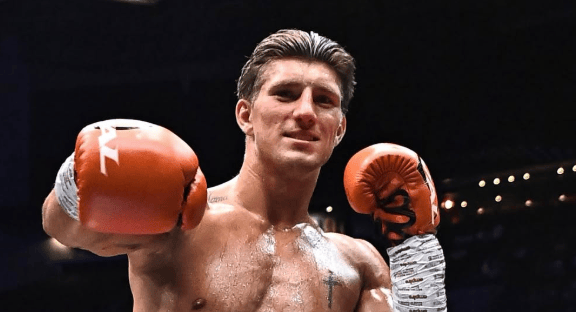
There is a strange place in boxing where a fighter can be doing everything right and still struggle to get the big fights.
Win too many fights, look too dangerous, and suddenly opponents have reasons to look elsewhere.
That may be exactly where Gradus Kraus finds himself.
The Dutch light heavyweight has become one of the most destructive young fighters in the sport, sitting at 12-0 with 11 knockouts and climbing rapidly towards the world-title picture.
At 175lbs, where the biggest names are already circling the championships, Kraus increasingly looks like the man nobody particularly wants to volunteer for.
He is the boogeyman of the division.
But boogeymen eventually have to be faced.
Kraus returns to action on November 28 in Amsterdam, and by then the 25-year-old from Oss could be closer than ever to the biggest fights of his career. He has stopped eleven of his twelve professional opponents, and his destructive style has made him one of the most dangerous rising contenders in the division.
The WBA ranks him at No.14, while the IBF has him at No.10.
He is no longer simply a prospect.
He is becoming a problem.
The KO threat at 175lbs
Kraus isn’t simply undefeated. He is destructive.
Eleven knockouts in twelve professional contests tells its own story, but the numbers don’t fully explain the problem he presents. His opponents rarely get the opportunity to settle into a fight, work out his rhythm or drag him into the later rounds.
Kraus has built his professional career around making opponents uncomfortable from the opening bell, and his power means there is very little room for error.
That is what makes him such an unattractive opponent for fighters already established at the top of the division. Beat him and you have defeated a young contender who was expected to be dangerous. Lose, and suddenly your career can be sent in a completely different direction.
Kraus is now approaching the point where the risk outweighs the reward when fighting him.
From Olympic disappointment to professional destruction
Kraus had originally hoped to make his mark through the amateur route, narrowly missing out on Olympic qualification before deciding to turn professional.
The Dutchman didn’t waste much time in thinking about the disappointments of the past.
Fight by fight, knockout by knockout, Kraus has built himself into one of Europe’s most intriguing light heavyweight prospects. Now, with a world ranking in two major sanctioning bodies, the early stage of his development is coming to an end.
The next step has to involve bigger names.
And that is where the problem begins.
His ranking is rising, his reputation is growing and his knockout percentage is frightening. The incentive to take him on voluntarily simply isn’t there.
For Kraus, however, the job is simple.
Keep winning.
Keep climbing.
Eventually, there will be nowhere left for them to go.
Peter Fury and the experience in his corner
One of the most significant advantages Kraus has is the team supporting him that include his father Albert, Peter Fury and Jon Maroz.
Peter Fury is not simply another experienced trainer on the team. He has operated at the highest level of professional boxing and knows exactly what it takes to develop a fighter capable of competing for world championships.
A trainer who has already navigated the politics, pressure and preparation required for top level boxing understands what happens when a dangerous prospect starts attracting attention. He knows how quickly expectations change, how opponents become more difficult to secure and how important it is not to rush the development of a fighter simply because the public wants bigger fights.
Fury is one of the most respected men in boxing and for a young prospect to have him in their corner, it is a big indication to those on the outside that Kraus is the real deal.
Following his father’s footsteps
Gradus has fighting in his blood.
His father, Albert “The Hurricane” Kraus, was a superstar of Dutch kickboxing and became the inaugural K-1 World MAX tournament champion in 2002. Albert competed at the highest level of the sport and became one of the most recognisable Dutch fighters of his generation.
For Gradus, that legacy could have been a burden.
Instead, it appears to have become fuel.
He grew up around gyms, fighters and championship belts, but rather than simply attempt to recreate his father’s career, he chose a different path. Albert conquered the world of kickboxing; Gradus will do it in boxing.
That makes the partnership between Albert and Peter Fury particularly intriguing.
In Albert, Kraus has a father who understands the fighter himself and the mentality required to survive at the highest level of combat sports. In Fury, he has a trainer with extensive experience of taking a gifted fighter through the professional boxing system and all the way to the top.
For a young fighter with world-title ambitions, it is a formidable combination.
The softer side of the boogeyman
Away from the gym, there is another side to Kraus that has become increasingly familiar to boxing fans.
He is a father himself, and his daughter has become part of his boxing journey.
Their dancing ring walks have gone viral, with Kraus and his daughter performing together before his fights. It is a wonderful contrast to the fighter audiences are about to see once the music stops.
The images of Kraus dancing with his daughter are not what you would expect from a fighter with eleven knockouts in twelve contests, but they reveal something important about him.
Family is central to Kraus.
His own father helped introduce him to the world of combat sports, and now his daughter is becoming part of his journey as he attempts to establish his own legacy.
For a few minutes before the bell, he is simply Dad.
Then the music fades, the fists are raised and the switch is flicked.
The warmth of the ring walk gives way to the cold reality of boxing.
The Ben Whittaker equation
The wider light heavyweight picture only makes Kraus’ situation more interesting.
Ben Whittaker defeated Ireland’s Conor Wallace in an IBF eliminator, putting himself in position for a shot at IBF champion Dmitry Bivol.
Whittaker’s path is now tied directly to the world-title picture, but there is history between the British star and Kraus’ promoter, BOXXER.
Whittaker turned professional with Ben Shalom’s promotional company before leaving for Eddie Hearn’s Matchroom, a move that ended his relationship with BOXXER after the company had guided him through the early stages of his professional career.
Now BOXXER has one of the division’s most dangerous young fighters in Kraus.
Whittaker is chasing Bivol.
Kraus is chasing everyone above him.
If both continue along their current trajectories, the promotional history only adds another layer to an already fascinating 175lbs landscape.
They can’t avoid him forever
For now, there are still plenty of reasons for the bigger names to look elsewhere.
Kraus is young. He is dangerous. He is unbeaten. He is popular. And, perhaps most importantly, he is becoming increasingly difficult to ignore.
But boxing rankings have a way of removing options.
There comes a point when a fighter can no longer be described as a prospect and the bigger fights become unavoidable.
Kraus is approaching that point.
On November 28 in Amsterdam, he will return to the ring with his father and Peter Fury in his corner, continuing a journey that began long before he became a professional boxer.
The dancing with his daughter may come before the fight. The smiles and family celebrations may come afterwards.
But between those moments stands one of the most dangerous young light heavyweights in boxing.
Gradus Kraus wants the champions.
He wants the biggest names.
And if the division would rather wait, he is perfectly happy to keep knocking people out until they have no choice.
They can avoid the Dutch boogeyman for now.
They just can’t avoid him forever.


Leave a comment